

Fork Theory
Or, what does chronic fatigue really feel like?

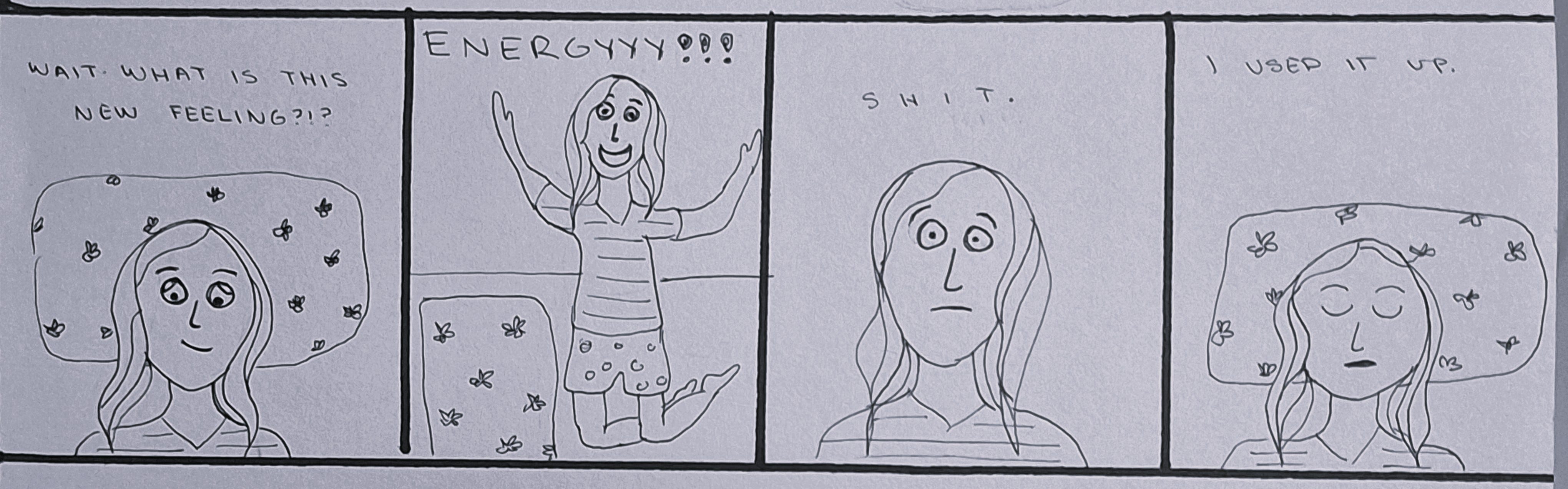
Chronic fatigue is one of those things that sounds simple, but is quite difficult to fully convey. When I try, like many others with ME/CFS, I’ve encountered disbelief, dismissal, impatience, and even outright hostility. I’ve heard things like: So what — we’re all exhausted. Get on with your life. You’re “just” depressed. It’s all in your head. Snap out of it.
With those reactions, it is a wonder any of us keep trying. Yet I think we all thirst to convey our experience. To be seen. If possible, to even be understood.
One way many folks do this is through Spoon Theory,1 a metaphorical framework that helps to explain energy limitations with some forms of chronic illness, neurodivergence, and disability. In sum, you start the day with a limited number of spoons (energy) and have to carefully decide how to allot them. Every day is different, and if you reach the end of your spoons but keep going, you are in effect borrowing spoons from the future — hence leading to energy crashes and related consequences.
I use it myself and see its utility, especially how it has given so many of us a simple framework for communicating our lived reality. Plus, memes.
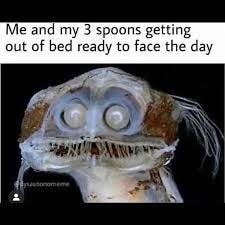
At the same time, part of me rebels at discussing a complex experience with cutlery. I sometimes lay awake at night considering alternatives. Forks? Stars? Quantum waves? A body full of fluttering humming-bird hawk-moths?
No matter what you use, the real problem with any metaphor is that in an attempt to deepen understanding, it also runs the risk of flattening experience.
And . . . do I really need to be understood?
I used to think so. But I’m not so sure anymore. After a lot of heartache, I’ve finally learned to turn inward for the validation I seek, to find shared intimacy with my chronic illness kin, to make peace with the fact that not everyone will understand.
And now, more than understanding, I crave compassion.
More than understanding, I crave listening and being listened to.
More than understanding, I crave creating space for all of our stories. I crave adding more shape and flavor and heft and texture. I crave holding nuance and complexity and difference. I crave giving and receiving care right in the midst of confusion and miscomprehension.
For those of you who also experience any kind of illness, I wonder what it really feels like, for you. And for those of you who do not, I wonder at the shape, flavor, heft, and texture of what lies most heavy on your body and your heart. I wonder, and regardless of how much I can ever truly and fully understand, I care.
And, if you are curious . . . here is what chronic fatigue really feels like, to me.
At times, chronic fatigue feels like shit.
The end.
(Just kidding.)
At times, chronic fatigue feels like being captured in the cage of my body.
My bones weigh hundreds of pounds. My brain is full of quicksand: my thoughts, few as they are, almost immediately swallowed up into the dark. My limbs move as if through a thick and murky swamp. It’s a deep tiredness of course, but so often accompanied by achiness, headaches, swollen glands, joint pain, and more, like having the flu. Yet it is a flu that never quite ends, that ebbs and flows in endless waves.
At times, chronic fatigue feels like running out of batteries.
Sometimes slowly, but more often suddenly. I’ve needed to sleep after any kind of physical activity, yes, but also after things like eating, becoming cold, reading a few pages in a book, or a brief conversation. I unexpectedly fall asleep on people’s beds, couches, and floors. I once had to sleep on the side of a busy walking trail because I couldn’t make it the 5 minutes back to my car. Even now, I keep a pillow in my car because of how many times I’ve had to pull over and sleep in parking lots or the side of the road. (I’ve also gotten in trouble by the cops for this — because apparently punishing people who appear to have no home to sleep in is the priority over, you know, actual safety and wellbeing).
At times, chronic fatigue feels like being a baby.
I half-joke that I enter “baby mode” during severe crashes, the only tasks I can possibly manage being to eat, sleep, and poop. Everything else — showers, answering messages, cleaning — is jettisoned. Even eating, while important, requires compromise. I’ve learned to subsist on smoothies and soups, to force down nutritious but unpleasurable meals that can be cobbled together in a few minutes, to go hungry when I can’t manage even that.
At times, chronic fatigue feels like thwarted desire.
My intense motivation for life does not match my capacity. I am filled with ideas, filled with passions, filled with yearnings that simply cannot be — at least, not right now. I feel desperate, vibrating with painful desire: to jump out of my skin, to run to dance to leap to swim, to do anything, anything, anything, but lay here for One. More. Second.
At times, chronic fatigue feels like a lesson in love.
When you only have a thimbleful of energy (Ooh! Thimble Theory!), you need to be very careful where you spend it. The essentials first, then if possible, the good stuff. Over time, I wryly realize what was never worth my energy: certain relationships, 99% of emails, putting up with people’s bullshit. And I more deeply recognize what always will be: laughter and play, nature and art, meaning and connection. And love. Always love.
At times, chronic fatigue feels like a running calculation in my head.
With every decision, I do the math: X many minutes of activity means Y many hours in bed. This applies to everything, from running an errand to cooking a meal to getting the mail. Yet frustratingly, it is not an exact science; it fluctuates and morphs and changes, day by day. While necessary to ensure I save enough precious energy for priority tasks, constant calculation comes with a steep cost: it requires a kind of hypervigilance, sending signals to my nervous system that I am not safe.
At times, chronic fatigue feels like being invisible.
I cannot meet my fundamental needs without significant help. And yet, I seem to have fallen through the cracks in the medical system, the cracks in the disability system, the cracks in my life. Every time I interact with those who do not see me as worthy of compassion, every time I’m told if I just tried harder I could support myself, every time my illness is treated as if it is not real, I have to fight hard against the feeling of being erased.
At times, chronic fatigue feels like a secret.
Many people don’t see the visibly sick me — they see the me I’ve dragged out into the light, determined to have a life. They look at me and exclaim, often with surprise and relief, “Wow you look so good!” They don’t see the days or weeks of recovery afterward, oft-accompanied by that awful wondering: was the fleeting joy worth the cost?
At times, chronic fatigue feels like slowing down.
I have spent so much time in stillness, so many weeks in bed, so many days unable to even open my eyes. It has not been easy, but it has been powerful. I have found beauty in decay, in falling apart, in lying fallow. The ways I create, write, love, connect, have all accumulated depth and intention. I have been given more time than most to take inventory of my life, to decide what meaning I will make, to spin new dreams, and ever so slowly, with ever so much space for transformation, begin working towards them.
At times, chronic fatigue feels like being a shadow of myself.
As years passed by with my energy and emotions so drastically muted, I began to believe being sick and tired, frozen and numb, was my entire personality. As I lost so many pieces of what used to constitute my identity — my former career, former hobbies and delights, former ways of making meaning — my illness seeped into these empty spaces, into my sense of self, into my dreams, until I could not always tell the difference between my symptoms and myself.
At times, chronic fatigue feels like a fever dream.
Confusing. Not quite real. Wildly debilitating for days, weeks, months at a time, then once it abates, feels like I must have made it all up. The way a crash can be so unpredictable, hitting days after an experience, just adds to the confusion — for myself, and for others. And until I worked through it, the doubt and the shame of wondering . . . is this all really in my head after all?
At times, chronic fatigue feels like being trapped in a Kafkaesque nightmare.
At one point, I could only avoid crashes by staying in bed — so essentially, preemptively acting tired so as not to become tired. I started a medication for chronic fatigue whose most common side effect is . . . you guessed it, fatigue. I created strong routines to better manage my energy expenditure, all the while further conditioning my body into when and how tired to be.
At times, chronic fatigue feels like forced isolation.
I am often home in bed, effectively cut off from most of my loved ones. While I long for rooted community, I have had to move 7 times in the last 6 years due to mold exposures and the inability to support myself financially. My friends are far flung, and my ability to keep in touch dramatically fluctuates. That being said, many of the relationships that have sustained through this time have also dramatically deepened.
At times, chronic fatigue feels like a call towards community.
More and more I see that we cannot do the work of healing alone. Nor I think, should we. As I build bonds with my fellow spoonies and sick bitches, I am ever more aware that while I may be lonely sometimes, I’m also not truly alone. And while I may not (yet) have a rooted community, there is a delicious and wild freedom in creating networks of care unconstrained by geography.
At times, chronic fatigue feels like a message.
A cry for help from my body, a message from my soul, a reflection of the bone deep weariness of our world. It reminds me that my body is doing her best, is valiantly keeping me alive, is trying so hard to tell me something important about myself and about this world. Our collective symptoms, whether it be the rise in chronic illness, the rise in toxins, or the rise in power-hungry billionaires, mean something after all. And the more we ignore them, the more we hurt.
At times, chronic fatigue feels like a curse.
Like Sleeping Beauty, I’ve pricked my finger on the world’s poisoned spindle and now I sleep my life away. For long periods of time, I exist in a strange purgatory, a kind of limbo where I know I am surely not dead, but also do not feel quite alive either.
And I wonder, lying there in bed, what is a life?
At times, chronic fatigue feels like a gift.
When I am able to look beyond fatigue and beyond pain and beyond meeting basic needs, simple joys take on whole new levels of magic and meaning and pleasure. I am filled to bursting with gratitude for beloved friends, for snuggly animals, for laughter, for the warmth of sunshine on my face, for tiny acts of kindness, for the smell of the sea salt air, for chocolate melting on my tongue, for really good hugs (you know the ones), for floating in water, for the sweet silliness of children, for meaningful conversations, for the shimmering quality of light through leaves.
And I wonder, could it be that a life is but a series of moments just like these?
Created by Christine Miserandino in 2003 as a way to describe her condition of lupus to a friend.