

Make a Wish
on the pros and pitfalls of manifestation messaging...

A few weeks ago, someone told me to put my hand over my heart and say the words: “I am healed.”
This person’s own heart was in the right place. Unlike many others I’ve encountered, she was not after my money, she deeply wanted to help me, and she genuinely believed in what she was saying.
And yet, the whole thing made me nauseous. Without knowing anything about my story, my illness, or my barriers to accessing care and services, this person decreed that I can manifest the health I desire by simply believing it to be so.
This is not uncommon advice. The wellness industry is overflowing with oversimplified messages on manifestation that make it sound like if we wish for something ardently enough, we can make it happen. Not only does this negate each of our unique paths in life, it also disregards the very real pain caused by war and other machinations of society that simply cannot be fought by one person, the myriad of circumstances outside our control, and the brutal reality that every single day, people are hurt, sick, dying, in every imaginable way, all while deeply, deeply wishing it were not so.
And.
Our wishes can have real effects on our lives, including our health. The brave act of belief can change our very biology as well as influence our conscious and subconscious actions, therefore making it more likely to come true. There is scientific evidence for the bodily effects our beliefs, thoughts, and emotions have, influencing our hormones, our immune system, our brains and nervous system, and even gene expression.
And of course there is the placebo effect, one of the most well-researched phenomena that we have. Through studies of fake pills, injections and even surgeries, on a wide range of diseases and injuries, it has been clearly documented that when someone is subconsciously conditioned to or outrightly believes even a “sham" treatment will help or even cure them, it can. However, we do not have robust evidence for placebos working in every condition - in fact, they have been shown to be remarkably ineffective for my umbrella condition of ME/CFS.1 In addition, synonymously linking “belief” to “placebo effect,” as it so often is, is not entirely accurate, as studies have revealed that at least some placebos can work without belief in a positive outcome.2
But what I find most miraculous is, regardless of the precise mechanism, the placebo appears to act as a catalyst for the body to heal itself.
I often forget that, I think. That ultimately, our bodies are orchestrating our living — and our healing — and our dying — with an innate intelligence we cannot yet begin to comprehend. We dress a wound, but the wound closes on its own, as if by magic. We eat, but our bodies manage how to absorb and alchemize it into something useful. We breathe, but a cascade of reactions imperceptible to us turns this breath into life.
Most of us cannot intimately and specifically describe how these seemingly simple mechanisms work either — but they do. And so it is not all that surprising to me that sometimes the body just needs a nudge to work its everyday magic.
Whether the end result is named due to belief, conditioning, a miracle, manifestation, or even self-delusion, I’m less interested in the label and more interested in the effect. And I care less about whether a treatment is “real” according to the scientific evidence we have available at this moment in time, and more about whether it will work.
So, my main question becomes this: How do we harness the power of belief in a way that heals rather than harms?
For harm, it can.
Belief can — and it has — caused people to ignore other complementary and evidence-based treatments or lifestyle changes, some of which may have saved their lives. Belief can — and it has — caused people to believe they can’t heal, also known as the nocebo effect, resulting in their sickness and even death. Belief can — and it has — caused people to believe so strongly in their treatment that they ignored the way it was not actually helping, or in fact, making them worse.
The way I see it, one of the key problems with this framework is that the psychological — or for some, the spiritual — component of wellness has become overweighted. Our beliefs, thoughts, wishes, prayers, are treated — and sold to others — as the only factor we need to heal. The wellness industry has neatly packaged this into an oversimplified ideal: You can think / pray / believe / manifest / wish your way into wellness.
But it is not enough to believe.
Not because our beliefs and our thoughts and our desires don’t matter to our health (they do), not because it never works (for some, it has), and not because there is no scientific evidence (there is). But because belief is only one part of the picture, one piece of the greater whole.
So when we tell vulnerable, sick, desperate people that they need to believe they can heal, have a positive mindset, release limiting beliefs, change unhelpful thoughts, train their brains — it’s not necessarily wrong. It becomes wrong, when we tell them this is all they need to do. It becomes wrong, when we guarantee it will definitely heal them. It becomes wrong when we tell them their illness and their wellness is fully under their control.
And.
I say this as someone who deeply believes in the power of wishes. In fact, I am a bit of a wish fiend. I wish when the clock shows repeat digits (i.e. 11:11, 2:22, 3:33). I wish during each and every full and new moon. I wish upon stray eyelashes, shooting stars, and 4-leaf clovers. I wish as I toss rocks with unbroken lines into the sea, and I wish as I observe the first star appear in the night sky.
Whether you call these wishes, prayers, or intentions, I have found great beauty and power in naming what I want. I have found great beauty and power in believing my wishes may come true. I have found great beauty and power in the way these acts of naming and belief draw me closer to what I most desire.
There are no guarantees I, nor anyone, will fully heal, no matter how much we believe. But that does not mean the journey is not worthwhile, for it lays bare the longing underneath it all: to live a life full of love, meaning, and joy. And if we listen closely, how to get there.
And so . . .
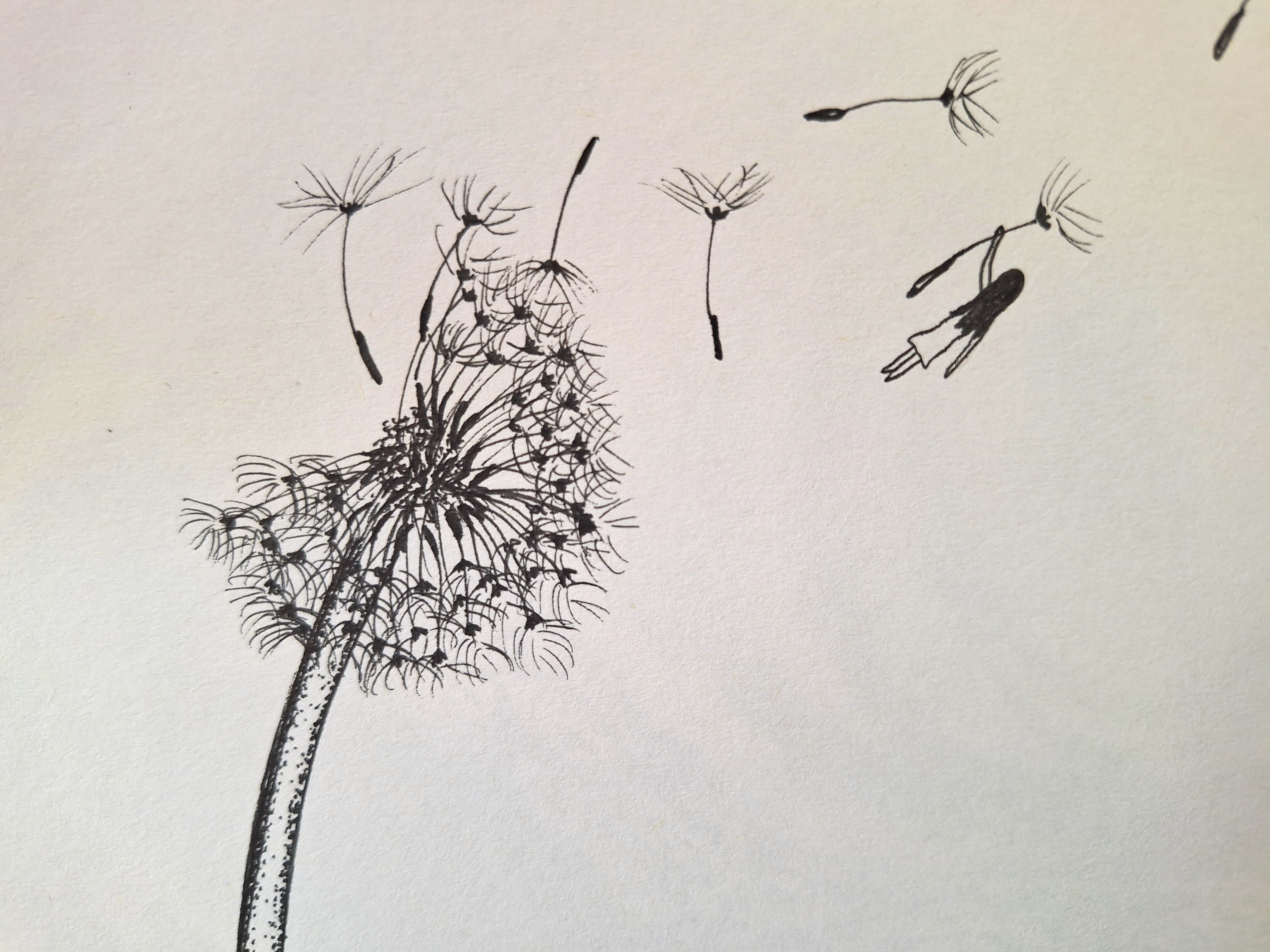
I close my eyes and imagine I am blowing the fuzzy head of a dandelion. My breath mingles with the wind, and the seeds drift off into a beautiful blue sky, glinting in the sunshine. Each seed is a wish, a fervent hope for my future. I choose one, and imagine it landing on soft, sun-warmed soil.
I know not every seed makes it, that like us, not every seed gets a chance to fully bloom. I know that like us, some seeds have harder journeys than others — perhaps through the dark twisty turmoil of a bird’s digestive tract, or stuck in stasis somewhere inhospitable. And I know that just like us, the success of each seed depends on many elements outside of my control.
But I water it anyway.
I tend to my wish the same way I tend to myself: with love and nourishment, with action and intention.
Every morning, I pray to the sun to shine its light on what brings forth most life. Every evening, I pray to the moon to release what no longer serves. Every day, I pray to all green and growing things to intertwine and strengthen its roots.
And every day, I lean in close and I whisper: I am healing.
Cho HJ, Hotopf M, Wessely S. The placebo response in the treatment of chronic fatigue syndrome: a systematic review and meta-analysis. Psychosom Med. 2005 Mar-Apr;67(2):301-13. doi: 10.1097/01.psy.0000156969.76986.e0. PMID: 15784798. https://pubmed.ncbi.nlm.nih.gov/15784798/
For example: Leisengang S, Schedlowski M, Hadamitzky M, Lückemann L. Taste-Associative Learning in Rats: Conditioned Immunosuppression with Cyclosporine A to Study the Neuro-Immune Network. Curr Protoc. 2022 Oct;2(10):e573. doi: 10.1002/cpz1.573. PMID: 36219717; PMCID: PMC11648820.